Articles › Systems & Processes
Systems & ProcessesXero, QuickBooks, Sage and Other Accounting Platforms Explained
Xero, QuickBooks, and Sage are the leading UK accounting platforms for SMEs. A fractional FD works across all major platforms and can guide you to the right choice for your business.
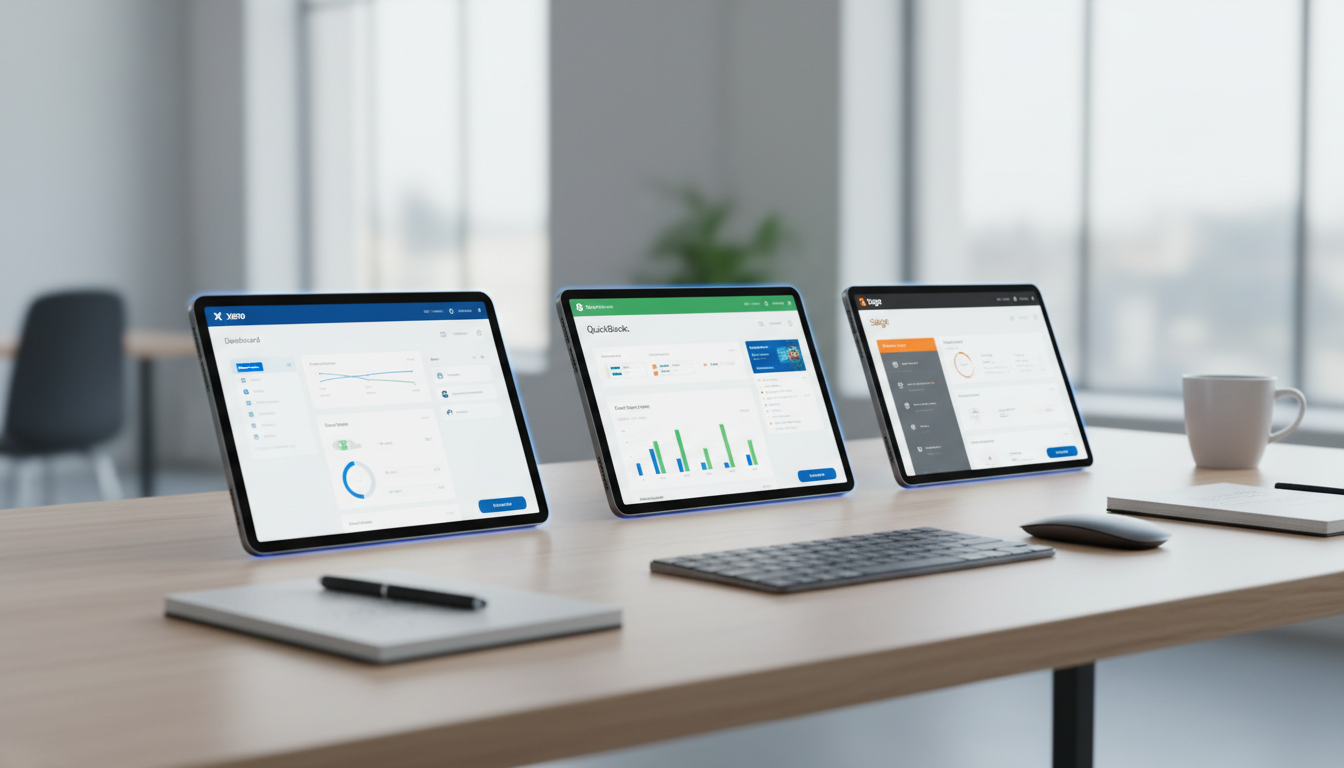
A fractional Finance Director works across all the major accounting platforms used by UK SMEs — Xero, QuickBooks Online, Sage Business Cloud, FreeAgent, and the mid-market systems such as Sage Intacct, NetSuite, and Microsoft Dynamics 365 Business Central. Platform fluency is a fundamental competency for any experienced FD operating across multiple client engagements, because the reality of fractional work is that every business you join has made different technology choices. The question is never which platform the FD prefers — it is which platform is right for your specific business.
This article explains how the major UK accounting platforms compare, where each performs strongest, and how a fractional FD uses their cross-platform experience to help you make the right choice — or get more from the platform you are already on.
The Main Cloud Accounting Platforms for UK SMEs
For businesses up to approximately £5m turnover with straightforward operational structures, the choice typically sits between three cloud accounting platforms that dominate the UK SME market. Each has genuine strengths and genuine limitations, and the right choice depends on your specific requirements rather than general reputation.
Xero
Xero has become the default choice for the majority of UK SMEs and their accountancy firms, and for good reason. Its bank reconciliation workflow is fast and intuitive, its ecosystem of third-party integrations is the largest of any UK accounting platform — with over 1,000 connected apps — and its reporting functionality is sufficient for most businesses below £5m turnover. Xero's multi-currency capability is genuinely good, making it particularly well-suited to businesses with international trading activity. The platform's open API makes it straightforward to connect to CRM systems, payroll platforms, and specialist reporting tools.
Xero's limitations become apparent at higher complexity. Its fixed assets module is basic. Project-level profitability tracking requires add-ons. Multi-entity consolidation is possible but requires Xero's Consolidated Reporting tool or a third-party solution. For businesses with these requirements approaching the £3m-£5m range, Xero can begin to feel like it is being pushed beyond its natural operating parameters.
QuickBooks Online
QuickBooks Online is Xero's closest competitor in the UK SME market and performs particularly well for businesses in the construction, trades, and professional services sectors. Its job costing and project profitability functionality is superior to Xero's native capability, and its payroll integration — through QuickBooks Payroll — is seamless. The platform's inventory management is also more capable than Xero's out-of-the-box, making it a stronger choice for product-based businesses that need stock tracking without investing in a dedicated inventory management system.
QuickBooks Online's ecosystem of integrations is smaller than Xero's but continues to grow, and its VAT handling for UK businesses is well-implemented and fully MTD-compliant. For businesses that need good job costing without significant additional investment in specialist add-ons, QuickBooks Online deserves serious consideration.
Sage Business Cloud Accounting
Sage's cloud accounting platform occupies a middle position in the market. It is the choice most familiar to businesses that have historically used Sage 50 desktop software and want to move to a cloud-based environment without a complete platform change. Sage's strength is its familiarity and the depth of its UK-specific compliance functionality — its VAT, payroll, and statutory reporting tools have been refined over decades of UK market focus.
For businesses that have invested heavily in Sage 50 expertise internally and are ready to move to cloud accounting, Sage Business Cloud provides the path of least disruption. Its integration ecosystem is narrower than Xero's, but for businesses whose primary requirement is robust accounting and compliance rather than a broad integrated technology stack, this is a reasonable trade-off.
Mid-Market Platforms for Growing Businesses
As businesses scale through £5m and approach £10m-£20m turnover, the limitations of SME accounting platforms become more constraining. Multi-entity structures, complex intercompany transactions, sophisticated project accounting, and the need for real-time consolidated reporting across business units typically push businesses towards mid-market ERP platforms.
Sage Intacct is a strong choice for service businesses, particularly those with multi-entity structures or the need for sophisticated dimensional reporting. NetSuite suits businesses with complex operational requirements — manufacturing, distribution, multi-territory e-commerce — where finance and operations need to be managed in a single integrated system. Microsoft Dynamics 365 Business Central is the natural choice for businesses already invested in the Microsoft ecosystem. Each of these platforms requires a more significant implementation investment than SME cloud accounting tools, which is why a robust business case is essential before committing — our article on building an ERP business case explores this in depth.
Platform-Agnostic FD Support
One of the most valuable aspects of working with an experienced fractional FD is that they bring genuine platform-agnostic perspective. They are not affiliated with any accounting software vendor, do not receive referral fees for recommending specific platforms, and have no incentive other than finding the right solution for your business. This independence is genuinely rare — your accountancy firm almost certainly has a preferred platform that shapes their advice, and software vendors obviously advocate for their own products.
"Our FD had used Xero, QuickBooks, and Sage across different clients. That cross-platform experience meant their recommendation was based entirely on what suited us — not what they were most familiar with."
A fractional FD can also help you get significantly more from the platform you already have. Many businesses are running perfectly good accounting software at 40% of its capability because it was never properly configured or because the team was not adequately trained on its features. Before recommending a platform change, a good FD will always audit what you currently have and establish whether the problem is the software or the way it is being used.
Integration and the Ecosystem Question
Accounting software does not operate in isolation. It needs to connect to payroll, expenses management, banking, CRM, and increasingly to operational systems that generate financial transactions. The integration ecosystem around your core accounting platform is as important as the platform itself, and a fractional FD evaluates the total technology stack rather than individual tools in isolation. For a detailed exploration of how finance systems connect with operational tools, see our article on integrating finance data with CRM and operational systems.
When evaluating platforms, the FD considers whether native integrations exist for the other tools your business uses, whether those integrations are reliable and well-supported, what the cost of integration middleware is where direct integrations do not exist, and how data flows between systems affect the quality and timeliness of management information.