Articles › Systems & Processes
Systems & ProcessesMoving From Spreadsheets to a Proper Finance System
Still running your finances on spreadsheets? A fractional FD can lead your transition to a proper finance system — reducing risk, saving time, and unlocking the management information your business needs.
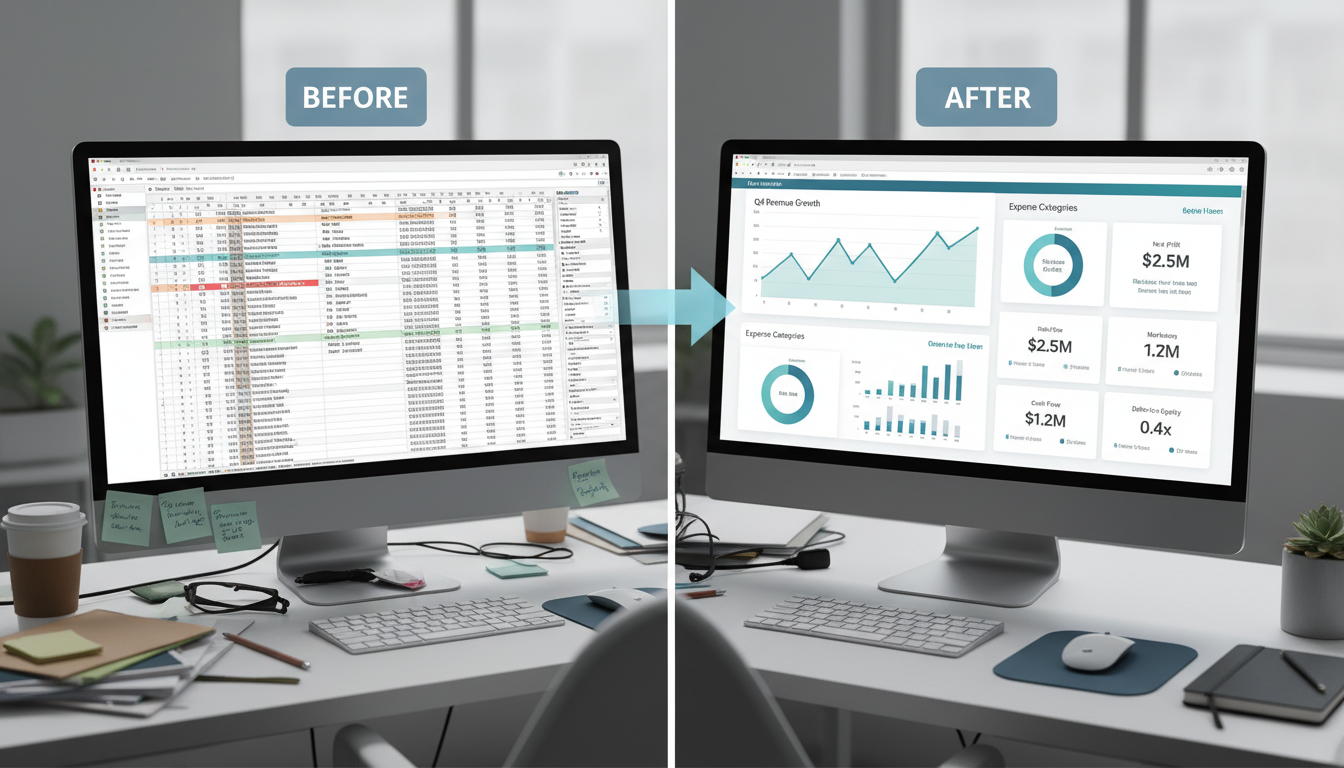
Spreadsheets are a remarkable tool. They are flexible, familiar, and free — which is why virtually every growing business relies on them heavily in its early years. But there comes a point where spreadsheet-based finance becomes a genuine liability. Data entry errors accumulate silently. Version control breaks down. Month-end becomes a multi-day exercise in reconciling files. Critical business information lives only in the memory of the person who built the spreadsheet. A fractional Finance Director recognises these symptoms immediately and knows how to lead the transition to a proper finance system without disrupting the business.
The question for most SME owners is not whether they need to move away from spreadsheet-dependent finance — it is when, and to what. A part-time FD answers both questions with precision, drawing on experience of making this transition across many different types of business.
The Real Risks of Spreadsheet-Dependent Finance
Business owners often underestimate how much financial risk they are carrying when core finance processes depend on spreadsheets. The risks manifest in several ways, each of which becomes more serious as the business grows.
Data integrity is the most immediate concern. Research consistently shows that the majority of spreadsheets containing more than a few hundred rows harbour material errors — misplaced decimal points, broken formulae, incorrect cell references — that go undetected until they cause a real problem. In a finance context, this means management accounts that are subtly wrong, VAT returns that contain errors, and cash flow forecasts that are built on flawed assumptions.
Key person dependency is equally dangerous. When the finance function is held together by a collection of spreadsheets that only one person fully understands, the business is acutely vulnerable to that person leaving, falling ill, or simply making a mistake that nobody else can identify. A proper finance system creates institutional memory — processes and data that are documented, consistent, and accessible to authorised users regardless of staff changes.
Scalability is the third major issue. Spreadsheets do not scale gracefully. A cash flow model that works perfectly at £500k turnover becomes unwieldy at £2m and unmanageable at £5m. Trying to run a multi-entity group, a multi-currency business, or a business with complex intercompany transactions on spreadsheets is genuinely risky — and the cost of cleaning up the mess typically exceeds the cost of implementing a proper system several times over.
What a Proper Finance System Actually Means
The phrase "proper finance system" means different things at different stages of growth. For a business turning over £500k to £2m, a proper finance system typically means a cloud accounting platform — Xero, QuickBooks Online, or Sage Business Cloud — configured correctly and used consistently by all members of the finance team. This alone eliminates the vast majority of spreadsheet risk.
Beyond Basic Accounting Software
For businesses between £2m and £10m turnover, a proper finance system usually means a core accounting platform supplemented by specialist tools for specific functions. This might include a dedicated cash flow forecasting tool such as Float or Futrli integrated with Xero, an expenses management platform such as Pleo or Soldo replacing paper receipts and manual expense claims, and an automated payroll system integrated directly with the accounting platform. The combination of these tools, properly integrated, eliminates most of the manual re-keying of data that makes spreadsheet-based finance so time-consuming and error-prone.
For businesses approaching £10m turnover or operating across multiple entities, a mid-market ERP system may be appropriate — platforms such as Sage Intacct, NetSuite, or Microsoft Dynamics 365 Business Central that consolidate finance, operations, and reporting in a single system. Our article on building an ERP business case explores this territory in detail.
The FD-Led Transition Process
A fractional Finance Director does not simply recommend a platform and leave you to get on with it. They lead the transition actively, taking responsibility for outcomes rather than just advice. The process typically unfolds across three phases.
Phase One: Current State Assessment
The FD begins by mapping every finance process that currently relies on a spreadsheet, assessing the volume and complexity of each, and identifying the points where errors are most likely to occur. This diagnostic work is essential — it determines the requirements that any replacement system must meet, and it often reveals process improvements that should be made regardless of the technology choice. Many businesses discover during this assessment that they have been maintaining duplicate records unnecessarily, or that certain manual processes can be eliminated entirely rather than simply automated.
Phase Two: System Design and Implementation
With requirements established, the FD selects and configures the appropriate combination of systems. Configuration matters enormously. An accounting platform set up with an ill-considered chart of accounts will produce management reports that are difficult to interpret and impossible to compare period-on-period. The FD designs the chart of accounts to mirror the management reporting structure the business needs, sets up cost centres or departments to enable divisional profitability analysis, and establishes the approval workflows and access controls that protect financial integrity.
Data migration is handled carefully, with historical data cleansed before import rather than simply copying across legacy errors. Opening balances are verified independently, and a parallel running period — where both old and new systems are maintained simultaneously — is used where the transition risk warrants it.
Phase Three: Embedding and Optimisation
The transition is complete only when the team is genuinely using the new systems confidently, the monthly reporting cycle is running smoothly, and the spreadsheets have actually been retired rather than quietly maintained as a shadow system. The FD monitors the first two or three month-end cycles post-implementation, resolving any issues and validating that the management information being produced matches expectations.
"We thought moving off spreadsheets would take six months and cause chaos. Our FD did it in ten weeks and the team actually found the new system easier to use from day one."
Measuring the Return on Investment
The business case for moving to a proper finance system is almost always compelling. Typical benefits include a reduction of 60-80% in the time spent on month-end close, elimination of the most common categories of finance error, and the ability to produce management accounts that are genuinely useful for decision-making rather than merely accurate in a technical sense. Staff time previously consumed by manual processes is redirected to analysis and insight — a significantly higher-value activity that directly supports better business decisions.
To understand how a proper finance system supports wider financial controls, read our article on reviewing and improving your finance processes and controls. And for businesses thinking about how finance data can connect with other operational systems, our guide on integrating finance data with CRM and operational systems explores the next stage of the journey.