Articles › Getting Started
Getting StartedPart-Time FD Pricing Models: Day Rate, Retainer or Project?
Part-time FD pricing models include day rates, monthly retainers, and project fees. Learn which charging structure suits your business and what each delivers.
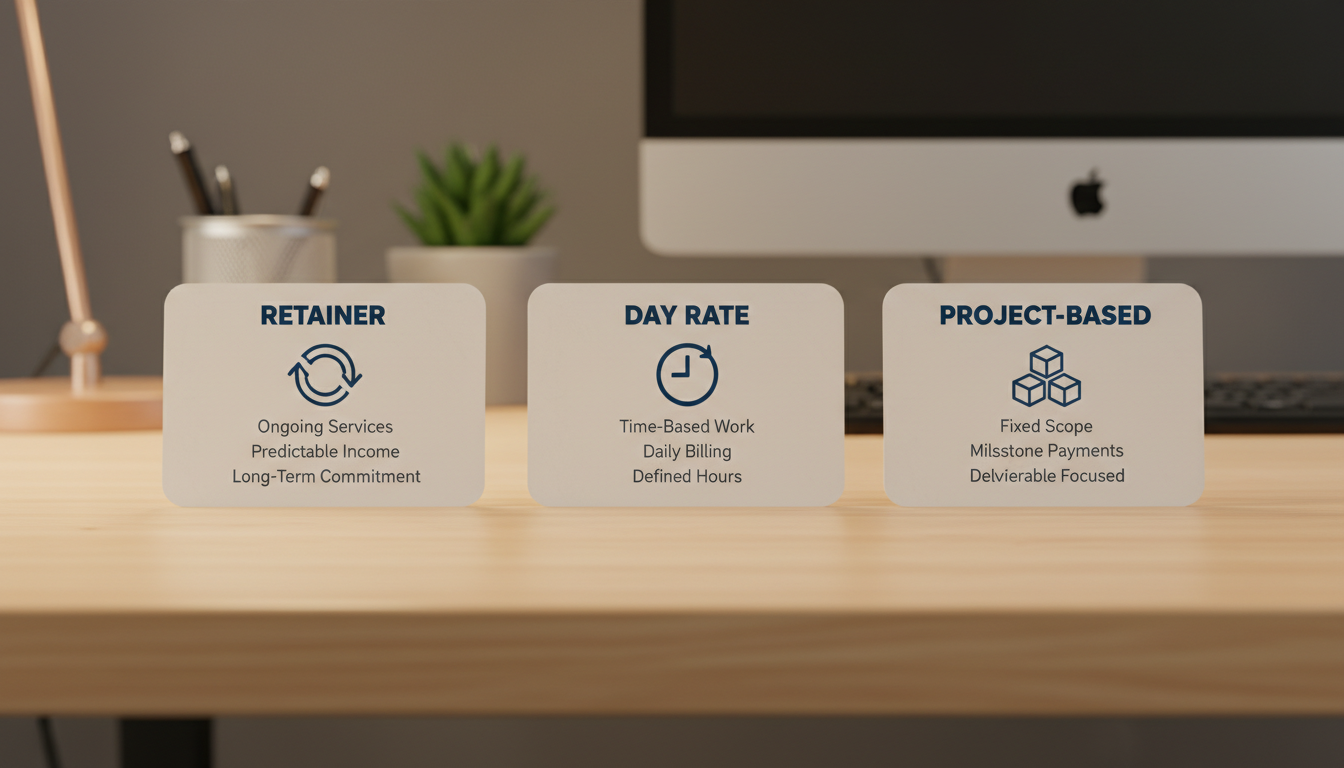
Fractional FD pricing models fall into three main structures: day rate engagements, monthly retainers, and fixed-price project fees. Each model suits a different type of business need, and choosing the right one can meaningfully affect both cost predictability and the quality of support you receive. This article explains how each model works, its advantages and drawbacks, and which structure FractionalFD recommends for different situations.
The Three Core Pricing Models Explained
1. The Day Rate Model
A day rate engagement means you pay an agreed fee for each day the FD works with your business, booked in advance on an ad hoc or rolling basis. Day rates for experienced fractional FDs in the UK typically range from £600 to £1,500 per day depending on seniority, sector specialism, and location.
2. The Monthly Retainer Model
A retainer agreement commits to a fixed number of days per month at an agreed rate, usually with a minimum contract term of three months. Monthly retainers for growing SMEs typically range from £1,500 to £5,000 per month covering two to five days of FD time.
3. The Project Fee Model
A project fee covers a defined piece of work — a fundraise, a business sale process, a financial systems implementation, or a restructuring — for a fixed or capped fee. Project fees vary enormously based on scope but commonly range from £3,000 to £25,000 for discrete engagements.
Day Rate Engagements: When They Work and When They Do Not
Day rate arrangements suit businesses that need targeted, short-term expertise without an ongoing commitment. They work well for:
- A one-off board presentation requiring financial narrative and analysis
- Due diligence support for an acquisition or investment
- A specific HMRC negotiation or VAT dispute
- Maternity or sickness cover for an existing Finance Director
The limitation of day rate engagements is continuity. An FD billing on a day rate basis has no structural incentive to invest deeply in your business, build institutional knowledge, or take genuine ownership of financial outcomes. For strategic, ongoing work — the kind that moves the needle on growth — a retainer provides substantially better outcomes.
The hidden cost of day rate arrangements
Day rates also tend to be higher per day than the equivalent time under a retainer, because the FD prices in the risk of inconsistent booking and the cost of acquiring and managing multiple clients. A retained FD working two days per month at an effective rate of £900 per day will often offer a lower rate than the same individual booked ad hoc, precisely because the retainer provides predictable income.
Monthly Retainers: The Gold Standard for Growing Businesses
A monthly retainer is the model most commonly recommended for SMEs seeking ongoing strategic financial leadership. The retainer model delivers several structural advantages that day rates and project fees cannot replicate:
- Continuity and context: A retained FD builds deep familiarity with your business, your people, your financiers, and your strategic goals. This context compounds in value over time.
- Predictable cost: A fixed monthly fee makes budgeting straightforward and avoids the invoice volatility that comes with ad hoc day rate billing.
- Proactive involvement: Retained FDs identify issues before they become crises. An FD who reviews your management accounts monthly spots a deteriorating debtor book in February rather than when it becomes a cash crisis in April.
- Board credibility: A retained FD can attend board meetings, interact with investors, and liaise with your bank as a genuine member of the leadership team — not as an external consultant dropping in occasionally.
What to expect in a retainer agreement
A well-structured retainer agreement will specify the number of committed days per month, the scope of activities included, the process for requesting additional days above the retainer, notice periods, and terms for scaling usage up or down. For a full breakdown of what should be included, see our detailed guide on what is included in a monthly FD retainer fee.
Project-Based Fees: Right for Defined, Bounded Work
Project fees work best when the scope of work is clearly definable and has a natural endpoint. Common project engagements include:
- Fundraise support: Preparing a financial model, investor deck narrative, and managing investor due diligence for a Series A or growth equity raise
- Business sale preparation: Preparing a business for sale including financial clean-up, EBITDA normalisation, and vendor due diligence readiness
- Finance system implementation: Selecting, configuring, and embedding a new ERP or accounting platform such as Xero, Sage Intacct, or NetSuite
- Group restructuring: Advising on a corporate restructure for tax efficiency, often in conjunction with your legal and tax advisers
Project fees provide budget certainty but can create misaligned incentives if not scoped carefully. An FD billing a fixed project fee has an incentive to complete the project efficiently, which is not always the same as completing it thoroughly. Ensure any project engagement includes clear deliverables, milestone sign-off points, and a mechanism for handling scope creep.
Hybrid Models: Combining Retainer and Project Fees
Many FractionalFD engagements operate as hybrids: a baseline retainer covering ongoing strategic financial leadership, supplemented by additional project fees when specific intensive work arises — a fundraise, an acquisition, or a system change. This model gives businesses the continuity benefits of a retainer while retaining flexibility for surge activity.
"The retainer covers the day-to-day rhythm of financial leadership. The project fee covers the moments that change the trajectory of the business. Smart businesses plan for both."
To understand how fixed and variable pricing elements interact in practice, see our article on fixed price versus variable FD pricing structures.
Which Pricing Model Is Right for Your Business?
A simple framework for choosing a pricing model:
- You need ongoing strategic finance leadership — choose a monthly retainer
- You have a specific, bounded project with a clear endpoint — consider a project fee with clear deliverables
- You need occasional, ad hoc expertise without a commitment — a day rate arrangement works, but manage your expectations on continuity
- You are in a period of significant business change — a hybrid model covering a retainer baseline with project fee top-ups gives maximum flexibility
For a full picture of what these costs translate to in absolute terms, read our guide on how much a part-time FD service typically costs. To understand how costs can flex with your business needs, see our article on scaling your part-time FD usage up or down.