Articles › Getting Started
Getting StartedPart-Time FD vs Full-Time: True Cost Comparison
A part-time FD costs £18,000–£60,000 per year versus £120,000–£200,000 for a full-time hire. See the true cost comparison and know which option suits your business.
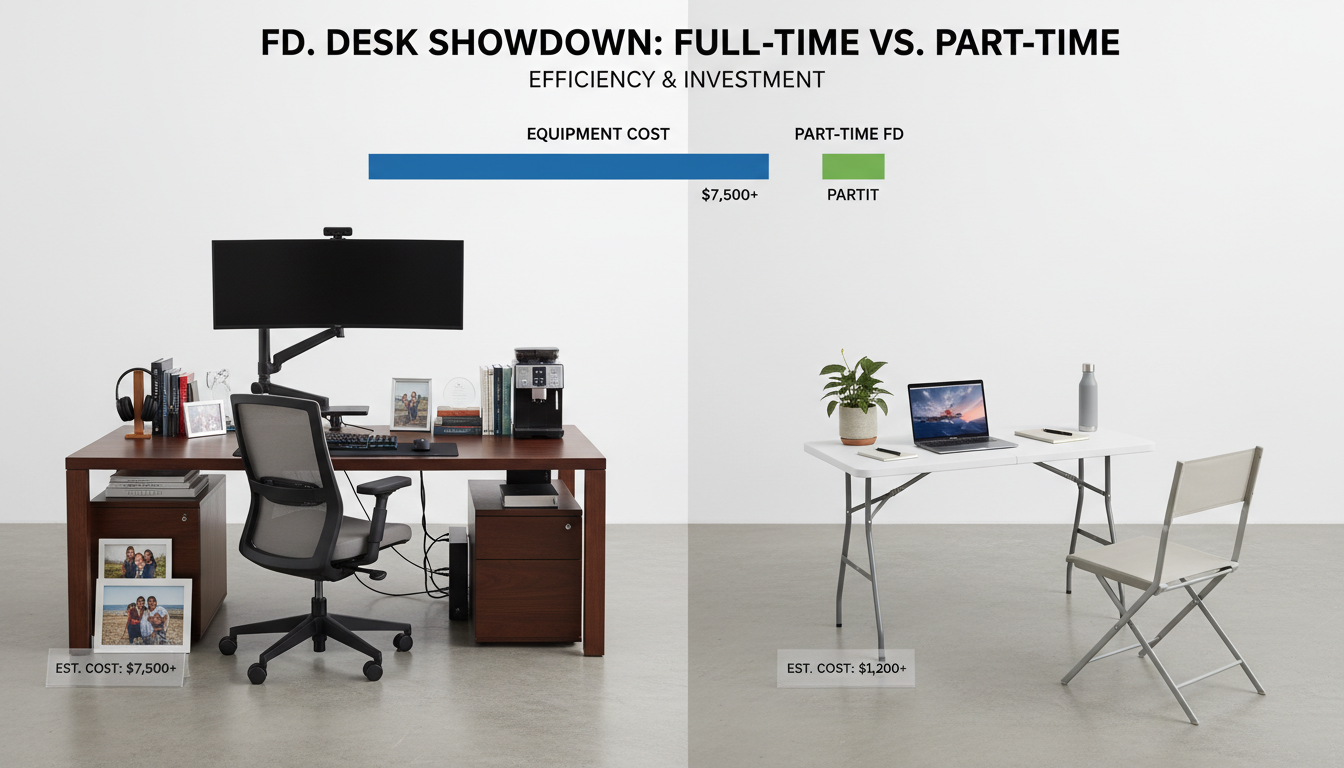
The cost of a part-time FD engagement ranges from £18,000 to £60,000 per year for most UK SMEs. A full-time Finance Director hired as an employee costs between £120,000 and £200,000 per year when you account for all employment costs beyond base salary. That gap — often £80,000 or more — is the core financial case for fractional engagement. But the comparison runs deeper than the headline cost differential.
The True Cost of a Full-Time Finance Director
Most businesses focus on the advertised salary when assessing the cost of a full-time FD hire. The salary is only the beginning. A realistic total employment cost calculation must include:
| Cost Element | Typical Range (per year) |
|---|---|
| Base salary (experienced FD, SME sector) | £90,000 – £150,000 |
| Employer's National Insurance (13.8% on earnings above £9,100) | £11,200 – £19,700 |
| Pension auto-enrolment (minimum 3% employer contribution) | £2,700 – £4,500 |
| Recruitment fee (typically 15–25% of first-year salary) | £13,500 – £37,500 (one-off) |
| Benefits: private medical insurance, life assurance, car allowance | £5,000 – £15,000 |
| Training, CPD, and professional subscriptions | £1,500 – £4,000 |
| Desk space, IT, and overhead allocation | £3,000 – £8,000 |
| Total annual employment cost (year 1 including recruitment) | £126,900 – £238,700 |
| Total annual employment cost (year 2+ excluding recruitment) | £113,400 – £201,200 |
These figures do not include the cost of garden leave during a notice period, potential compromise agreement costs if the hire does not work out, or the management time consumed in performance management and potential redundancy proceedings.
The True Cost of a Part-Time FD Engagement
A part-time FD engagement on a monthly retainer delivers the following annual cost profile:
| Engagement Level | Days Per Month | Monthly Cost (ex. VAT) | Annual Cost |
|---|---|---|---|
| Light touch (early-stage business) | 1–2 days | £1,000 – £2,000 | £12,000 – £24,000 |
| Standard growth engagement | 2–4 days | £2,000 – £4,000 | £24,000 – £48,000 |
| Intensive scale-up support | 4–6 days | £3,500 – £6,000 | £42,000 – £72,000 |
Even at the intensive end, a fractional FD engagement costs less than half of a full-time equivalent. For businesses at the standard growth engagement level, the saving versus a full-time hire is typically £80,000–£150,000 per year.
What the Part-Time Model Delivers That Full-Time Cannot
Beyond cost, fractional FD engagements offer structural advantages that a full-time hire cannot replicate:
Breadth of experience at a fraction of the cost
A fractional FD working across three to five client businesses simultaneously brings a current, cross-sector perspective that a full-time employee working in a single business for several years typically cannot match. They have seen how competitors structure their finances, what banks are currently prioritising, and what best practice looks like across multiple sectors simultaneously. This breadth of experience is a core part of the value proposition.
No fixed overhead commitment
A full-time FD represents a fixed employment commitment that persists through downturns, flat periods, and business pivots. A fractional engagement scales with your needs — more intensive during a fundraise or acquisition, lighter during periods of steady-state operation. This flexibility has real economic value that does not show up in a simple cost comparison. For more on this, see our article on scaling your part-time FD usage up or down.
Faster time to value
A full-time FD hire typically takes three to six months from decision to first day of productive work — time for recruitment, notice period, and onboarding. A fractional FD sourced through FractionalFD can be operational within two to three weeks. For businesses facing an immediate challenge — a banking covenant breach, a fundraise timeline, a cash flow crisis — this speed is invaluable.
When a Full-Time FD Is the Right Choice
The fractional model is not universally superior. A full-time Finance Director is typically the right choice when:
- Your business exceeds £15m–£20m in turnover with a complex, multi-entity group structure requiring daily financial oversight
- You are a listed company or preparing for a public offering, where regulatory requirements demand a full-time, named CFO or FD
- Your business has a large in-house finance team requiring full-time senior leadership to manage effectively
- The FD role is operationally intensive — managing daily banking, running a large finance department, or overseeing complex daily treasury operations
For the majority of UK SMEs between £1m and £15m in turnover, the fractional model delivers equivalent strategic financial leadership at a fraction of the total employment cost.
"The part-time model is not about getting less. It's about getting exactly the level of financial leadership your business actually needs, rather than paying for a full-time overhead your current stage cannot justify."
Making the Right Decision for Your Business Stage
The decision between full-time and fractional FD is fundamentally a function of your business's current financial complexity, growth stage, and budget. A business at £3m turnover with three finance team members does not require a full-time FD — it requires strategic oversight, commercial challenge, and external credibility, all of which a fractional FD delivers at a fraction of the cost.
To understand the full value picture beyond cost, read our analysis of the return on investment from a part-time FD engagement. For cost structure specifics, see our guide on how much a part-time FD service typically costs.