Articles › Cash Flow
Cash FlowHow Will You Improve Our Cash Conversion Cycle?
Learn how a fractional Finance Director improves your cash conversion cycle by reducing debtor days, optimising stock turn, and extending supplier terms.
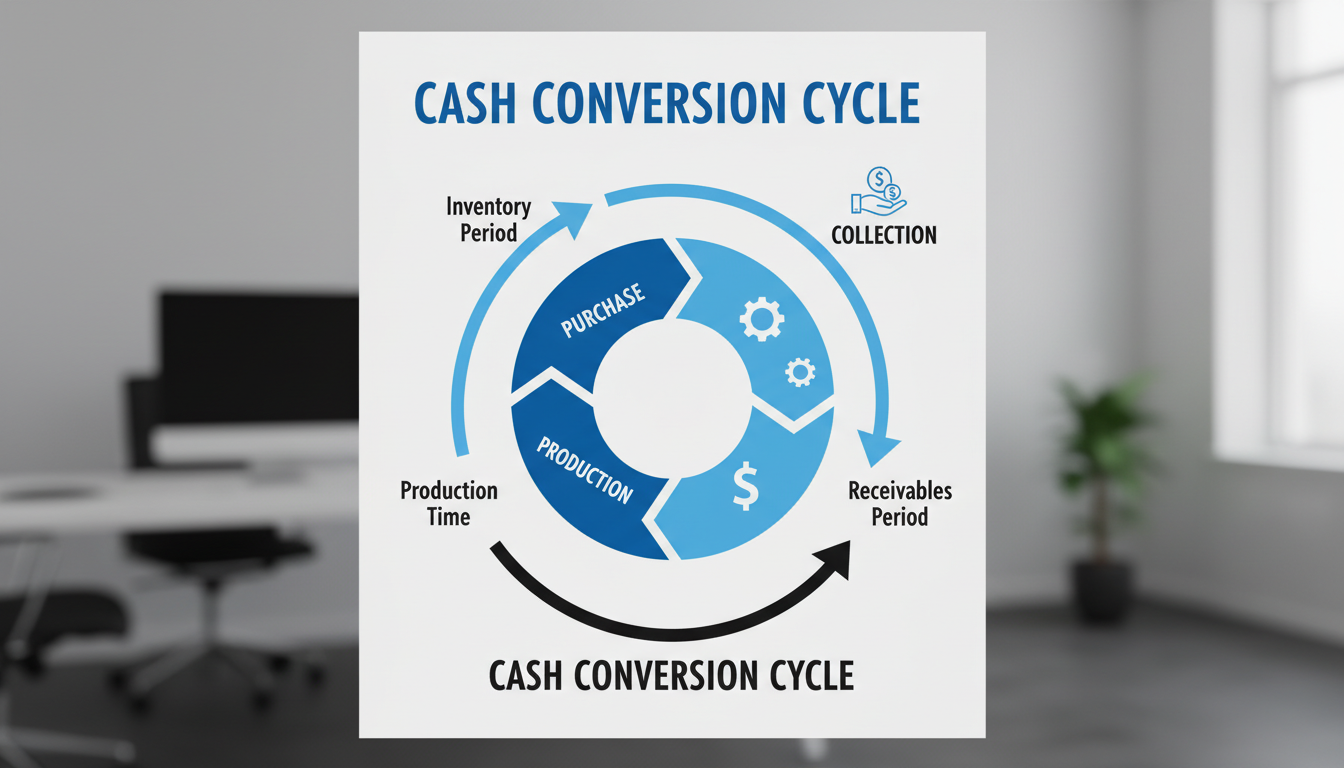
The cash conversion cycle (CCC) is one of the most powerful metrics in business finance, yet many UK SME owners have never heard of it. It measures how long it takes a business to convert its investments in inventory and operations into cash flow from sales. The shorter the cash conversion cycle, the less working capital a business needs to sustain its operations — and the more financially resilient it becomes. Improving the CCC is a core discipline for any fractional Finance Director working with growing businesses.
What Is the Cash Conversion Cycle?
The cash conversion cycle is calculated as: Days Sales Outstanding (DSO) + Days Inventory Outstanding (DIO) − Days Payable Outstanding (DPO). Put simply, it answers the question: from the moment you spend money to deliver your product or service, how many days does it take before you receive cash from your customer?
A manufacturer buying raw materials on 30-day terms, holding stock for 20 days, and then waiting 45 days for customers to pay has a cash conversion cycle of 35 days (30 + 20 − 45 = 5 days… however if payment terms are net 30 for suppliers and net 60 for customers, the cycle lengthens dramatically). For a high-growth business, every additional day in the CCC requires additional working capital to fund it.
Why a Long Cash Conversion Cycle Creates Real Business Risk
When a business is growing rapidly, a long cash conversion cycle becomes a structural threat. Every pound of new revenue requires working capital to fund the gap between spending and collection. Without careful management, rapid growth can actually accelerate a cash crisis — a phenomenon sometimes called "overtrading." A fractional FD identifies this risk early and implements the working capital improvements needed to grow sustainably.
The Three Levers of Cash Conversion Cycle Improvement
A fractional Finance Director will work across all three components of the cash conversion cycle simultaneously, prioritising the interventions that will deliver the greatest improvement in the shortest time.
Lever One: Reducing Days Sales Outstanding
DSO measures how long it takes customers to pay after an invoice is raised. Reducing DSO is often the quickest win available. Key interventions include:
- Tightening credit control processes — structured follow-up sequences starting before the invoice is even due.
- Reviewing and shortening payment terms offered to customers, particularly for lower-value or newer accounts.
- Introducing early payment discounts where the cost of the discount is less than the cost of the working capital freed up.
- Improving invoicing accuracy so that invoices are not disputed on receipt, which is one of the most common causes of delayed payment.
- Segmenting the debtor ledger to focus collection effort on the highest-value overdue accounts first.
In most UK SMEs, addressing credit control processes alone can reduce DSO by 5–15 days within the first quarter of a new engagement — releasing material cash from the working capital cycle.
Lever Two: Optimising Days Inventory Outstanding
For product businesses, DIO represents the time stock sits in the business before being sold and invoiced. Excess inventory is frozen cash. A fractional FD will work with operations to identify slow-moving stock, improve demand forecasting, and introduce minimum order quantity disciplines that prevent over-buying. In some cases, consignment stock arrangements with key suppliers can significantly reduce the cash tied up in raw materials.
Lever Three: Extending Days Payable Outstanding
DPO measures how long a business takes to pay its own suppliers. Extending payment terms — done constructively and collaboratively — creates a natural offset to the working capital cycle. A fractional FD will negotiate improved supplier payment terms as part of a broader working capital strategy, ensuring the business benefits without damaging critical supply relationships.
Measuring and Tracking the Cash Conversion Cycle
Improvement cannot be managed without measurement. A fractional Finance Director will establish a simple working capital dashboard that tracks DSO, DIO, and DPO on a monthly basis, alongside the overall cash conversion cycle figure. This creates accountability and allows the management team to see the impact of changes in real time.
"A 10-day improvement in the cash conversion cycle for a £5m turnover business can release over £130,000 of working capital — effectively a free loan from the business's own operations."
The dashboard is typically integrated into the monthly management accounts pack, sitting alongside the P&L, balance sheet, and rolling cash flow forecast to give the board a complete picture of financial health.
Service Businesses and the Cash Conversion Cycle
The cash conversion cycle concept applies equally to service businesses, although the DIO component is replaced by work-in-progress (WIP) — time spent on client work that has not yet been invoiced. Many professional services firms, agencies, and consultancies carry substantial hidden WIP that represents cash already spent but not yet billed. A fractional FD will examine billing practices and help the business move towards more frequent or milestone-based invoicing to accelerate cash collection from completed work.
Achieving Sustainable Working Capital Efficiency
Improving the cash conversion cycle is not a one-time project — it requires ongoing discipline and monitoring. The businesses that maintain strong working capital positions are those that have embedded good practices into their standard operating procedures: prompt invoicing, proactive credit control, sensible stock management, and strategically managed supplier terms. A fractional Finance Director provides the ongoing oversight to ensure these disciplines are maintained as the business grows and evolves. The payoff is a business that can fund its own growth from its own operations — with far less dependence on external borrowing.