Articles › Cash Flow
Cash FlowCan You Build Us a Rolling Cash Flow Forecast?
A fractional Finance Director builds rolling cash flow forecasts that give UK businesses 13-week visibility and the confidence to make informed financial decisions.
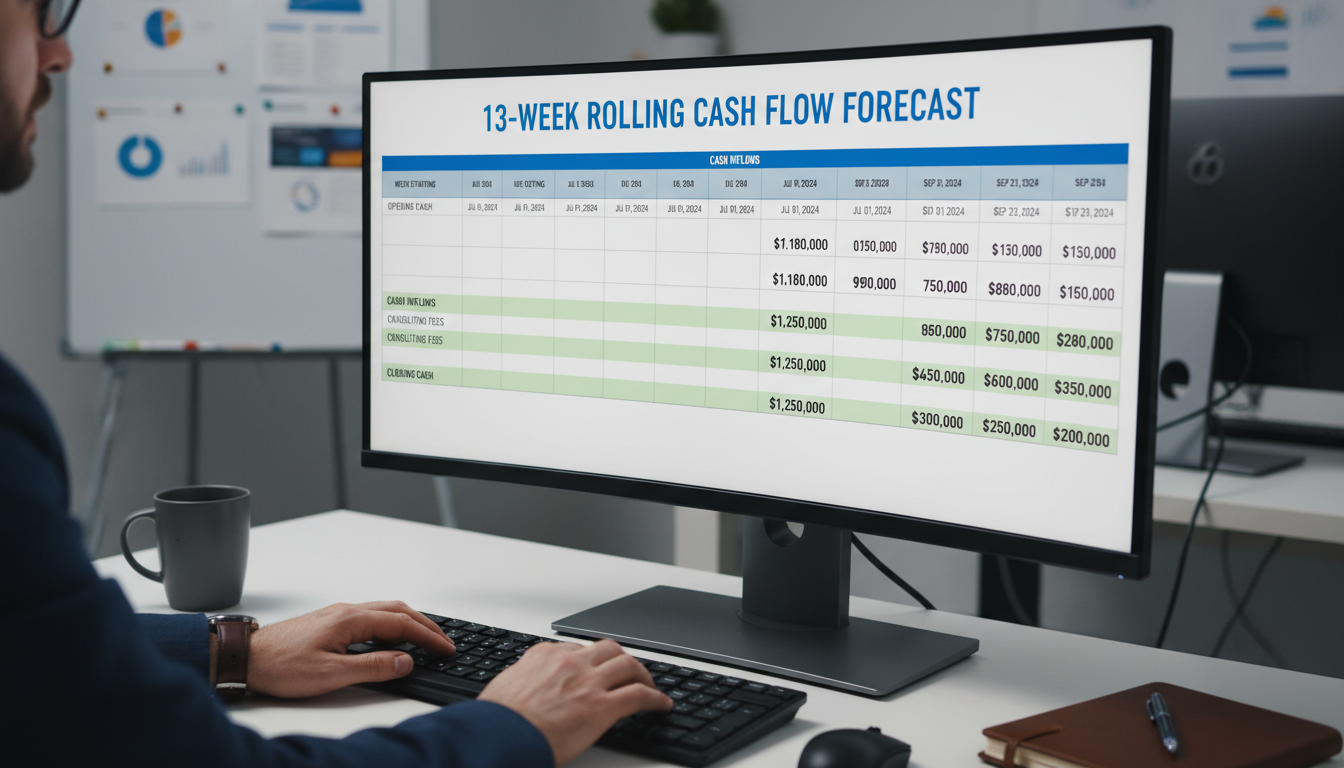
A rolling cash flow forecast is arguably the most important financial tool a growing UK business can have. Yet the majority of SMEs operate without one — relying instead on last month's bank statement or a rough mental model of when money is due in and out. A fractional Finance Director will build and maintain a robust rolling cash flow forecast as one of the foundational elements of any finance engagement, giving management the visibility they need to make confident, informed decisions.
What Is a Rolling Cash Flow Forecast?
A rolling cash flow forecast is a forward-looking model that projects the business's cash inflows and outflows week by week — typically over a 13-week (three-month) horizon. Unlike a static annual budget that becomes increasingly irrelevant as the year progresses, a rolling forecast is updated weekly and always looks the same distance ahead. As one week passes, a new week is added to the end — hence "rolling."
The 13-week timeframe is the standard used by turnaround professionals, lenders, and boards of listed companies precisely because it is long enough to be meaningful for planning but short enough that the underlying assumptions remain grounded in reality. It gives management a full quarter of visibility into the cash position at any moment in time.
The Difference Between a Cash Flow Forecast and a P&L Forecast
A common misconception is that a profit and loss forecast and a cash flow forecast tell you the same thing. They do not. A business can report a healthy profit and still run out of cash if it collects from customers slowly, pays suppliers quickly, or invests heavily in stock or equipment. The rolling cash flow forecast operates on an entirely different basis — it models actual cash movements, not revenue and cost recognition — making it an indispensable complement to the P&L in the management accounts pack.
How a Fractional FD Builds the Forecast
Building a high-quality rolling cash flow forecast requires both technical skill and a deep understanding of the business's operating model. A fractional Finance Director will typically follow this process:
Step One: Establish the Base Data
The starting point is always the current bank balance and a clear picture of committed cash flows over the next few weeks — invoices already raised and awaiting payment, supplier invoices already received, payroll commitments, and any known capital expenditure. This gives the model a factual foundation rather than an estimated starting position.
Step Two: Model Inflows by Customer and Revenue Stream
Rather than applying a single average collection assumption, a well-built forecast models cash inflows by customer or customer segment, applying the actual payment terms and observed collection behaviour of each. A customer who consistently pays at 45 days should be modelled at 45 days — not at the nominal 30-day terms on the invoice. This granularity makes the forecast meaningfully more accurate than a simple average-based model.
Step Three: Model Outflows in Full Detail
Outflows are modelled by category: payroll (including PAYE and NI), supplier payments, rent, rates, utilities, loan repayments, VAT, corporation tax instalments, and any other regular or anticipated cash commitments. The fractional FD ensures that irregular but large payments — such as quarterly rent, annual insurance premiums, or dividend payments — are captured in the week they will actually leave the bank account.
What the Rolling Cash Flow Forecast Reveals
Once built, the rolling forecast immediately surfaces information that management simply cannot see from the bank balance alone:
- Pinch points: Specific weeks where outflows exceed inflows and the cash balance dips, even if the overall position looks comfortable.
- The impact of growth: How winning a new contract, hiring additional staff, or investing in equipment will affect the cash position over the coming weeks.
- The timing of tax liabilities: VAT quarters and corporation tax instalments can cause significant cash outflows that are easily missed without a forecast.
- The headroom against banking facilities: If the business has an overdraft or revolving credit facility, the forecast shows how close the business will come to its limits and when.
"A rolling cash flow forecast does not eliminate financial uncertainty — but it ensures that surprises are visible weeks in advance, not days after the fact."
Maintaining Forecast Accuracy Over Time
The value of a rolling forecast comes from its ongoing accuracy, which depends on weekly updates and regular variance analysis. A fractional Finance Director will compare actual cash movements against forecast each week, identify variances, understand their causes, and update forward assumptions accordingly. Over time, this process improves the forecast's accuracy and also reveals systematic issues — such as customers consistently paying later than expected — that feed back into broader working capital improvement work.
The forecast is also a key input into cash flow early warning systems, alerting management to potential shortfalls with enough lead time to take corrective action — whether that is accelerating collections, delaying discretionary expenditure, or drawing on a facility.
How Far Ahead Should the Forecast Look?
The 13-week rolling model addresses the immediate operational cash position. For strategic planning purposes, a fractional FD will also maintain a longer-range cash flow projection — typically integrated into the annual budget and three-year plan — that models the cash implications of strategic decisions such as hiring plans, capital investment, and market expansion. These longer-range projections are less granular but equally important for ensuring the business has the capital it needs to execute its strategy. For a detailed discussion of forecasting horizons, see our article on how far ahead cash flow forecasting should look.
Integrating the Forecast into Business Decision-Making
The real power of a rolling cash flow forecast is unlocked when it becomes part of how the business makes decisions — not just a report produced by the finance team. A fractional Finance Director will work with the management team to use the forecast as a live planning tool: running scenarios before committing to large expenditure, timing capital purchases to avoid pinch points, and using the forward cash position to negotiate from a position of strength with lenders and suppliers.
If your business is currently operating without a rolling cash flow forecast, engaging a fractional Finance Director to build and maintain one is one of the highest-return investments available in financial management. Explore our engagement models to understand the options.